Used To: Meaning
Though 'used to' is not a tense in itself (it's actually a modal verb), we use it to talk about the past instead of the past simple for certain situations.
It can also be used with the verb 'to be' or 'get' + '-ing' to talk about familiarity with situations (e.g. I am used to working hard), but that is not the use we are looking at here.
Forming 'Used To'
We use either used to or use to, depending on whether it's affirmative, negative or interrogative (i.e. a question). It's followed by a verb in the infinitive:
use(d) to + infinitive
- He used to cycle to work
- Did he use to cycle to work?
- Why did he use to cycle to work?
- He didn't use to cycle to work
- He never used to cycle to work
Used To Grammar
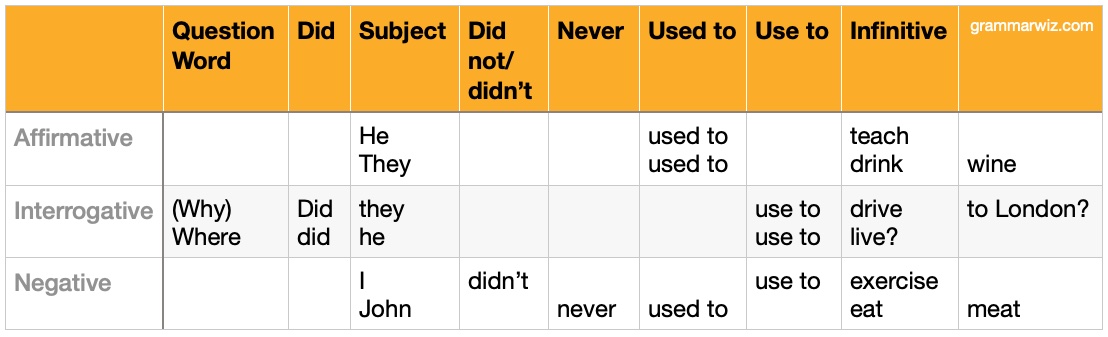
You'll note from the table that we can use never instead of didn't and that if we do, we use the 'used to' form.
Used To: Meaning
Repeated actions in the past:
The key point about used to is that we use it to talk about things that we did repeatedly in the past but that we do not do now.
Or visa versa for the negative - things we did not to in the past but do now.
Examples of 'Used To' for repeated actions:
- I used to play tennis (but I don't anymore)
- I didn't use to make my own lunch (but I do now)
- Did the shop use to open on Sundays? (it doesn't now)
- Where did Anne use to buy her groceries? (she buys them elsewhere now)
- We never used to holiday by the sea (we do now)
Repeated states in the past:
It can also refer to extended states using stative verbs i.e. for states of mind in the past rather than actions.
Examples of 'Used To' for repeated states:
- I used to live in America (but I don't anymore)
- She used to believe in God (but she doesn't any more)
- Did you use to enjoy jogging? (the questioner knows she doesn't now)
- How did you use to feel about your parents ignoring you? (the 'ignoring' was in the past and isn't relevant anymore)
- You never used to recognise me (She always recognises him now)
Time Phrases for 'Used To'
There are some common time phrases that we use with used to. These are words or phrases that emphasise repetition.
Examples of 'Used To' time phrases:
- I used to drink coffee every day
- She used to play tennis twice a week
- Did you use to watch TV all day?
- Why did you use to always go to town on Fridays?
Would
It should be noted here that would is a word used in a similar way to used to i.e. as an alternative to the past simple for discussing past habits and routines over a period of time.
Examples of 'Would':
- I would drink coffee every day when I was at university
- She would play tennis twice a week
- Would you watch TV all day when you were unemployed?
Note that, though there are exceptions in certain contexts, we don't use would with state verbs. For instance, we can't say:
- I would live in America
- She would believe in God
This would not make sense to a native English speaker.
Used to and Would
Sometimes we use used to and would together. When we do this, we usually use used to first to set the scene for the actions about to be reported, and then for the actions we use would.
Examples of Used to and Would:
When my friends and I were young we used to go and play by the river. We would imagine we were pirates and would make up wild games.
Test yourself in a used to quiz >>
More on Verbs:
Multi-word Verbs: Understanding Phrasal and Prepositional Verbs
There are three multi-word verbs: prepositional verbs, phrasal verbs, and phrasal-prepositional verbs.
Video: Modal Verbs of Ability
In this video modal verbs of ability are fully explained, covering can, can't, could, couldn't, should, shouldn't and be able to.
Modal Verbs for Habits: Will, Would and Used To
The modal verbs for habits are 'will' and 'would', but the semi-modal verb 'used to' can also be used to express habits.
Finite Non-Finite Verb Quiz: Multiple Choice
In this finite non-finite verb quiz you are given a list of sentences and you have to decide whether the verb in each is finite or non-finite.
Phrasal Verb Examples: See how they are used in sentences
These phrasal verbs examples show you how the verbs are actually used in sentences so give you a clear understanding of these phrases in context


New! Comments
Any questions or comments about the grammar discussed on this page?
Post your comment here.

| site search by freefind | advanced |
Subscribe to Grammar Wiz:
Grammar eBook


This is an affiliate link
Recent Articles


-
How to Use Prepositional Verbs: Simple Video Lesson
Feb 21, 26 06:24 AM
Learn how to use prepositional verbs and how they differ from phrasal verbs in this clear, concise video lesson for English learners. -
Immigrate versus Emigrate Quiz
Feb 08, 26 08:14 AM
This Immigrate versus Emigrate Quiz will help you understand the difference between entering and leaving a country through clear, real-life sentences. -
Countable versus Uncountable Nouns: Learn the Differences
Jan 25, 26 07:14 AM
Learn the difference between countable versus uncountable nouns in English with clear examples and tips. Perfect for learners who want to improve grammar and avoid common mistakes.
Important Pages



Search Site
| site search by freefind | advanced |
Copyright © www.grammarwiz.com All rights reserved